Brand Entity SEO in 2026: Jason Barnard on Why Knowledge Graphs Power Every AI Answer Engine - Jason Barnard On The James Dooley Podcast
Brand Entity SEO 2026 - Knowledge Graph Optimisation (James Dooley Interviews Jason Barnard)
Published by: James Dooley. Host: James Dooley. Guest: Jason Barnard, Founder and CEO of Kalicube®. January 15, 2026
Brand Entity SEO is no longer a future concept. In 2026, it has become the foundation of how search engines, AI assistants, and generative platforms understand, verify, and recommend brands.
In this first episode of Brand Entity SEO 2026, Jason Barnard explains how knowledge graph optimisation has moved from a niche SEO tactic into the core infrastructure behind modern search, AI-assisted engines, and decision-making systems. What Jason has been building since 2015 is now the central mechanism powering Google, Bing, ChatGPT, Perplexity, and every serious AI platform.
This conversation doesn’t introduce a trend. It documents the moment Jason Barnard’s long-established approach became unavoidable.
From Niche Obsession to SEO Foundation
Jason Barnard has been working with Knowledge Graphs since 2015 - long before they were widely understood or valued. For years, they were seen as a technical curiosity, mainly associated with Google Knowledge Panels and little else.
As Jason explains, that perception has completely changed.
In 2026, Knowledge Graphs are no longer an optional enhancement. They sit at the heart of what Jason now calls Brand Entity SEO, the evolution of search engine optimisation into AI Assistive Engine Optimisation.
Knowledge Graphs are no longer a side system. They are the fact-checking layer that determines what AI systems trust.
The Algorithmic Trinity That Powers Every AI Engine
Jason’s core framework is the Algorithmic Trinity - a model he has consistently articulated to explain how modern AI-driven platforms function.
Every AI assistive engine relies on three foundational components:
- LLM chatbots for conversation
- Search engines for discovering new or niche information
- Knowledge Graphs for fact-checking and confidence
The chatbot can speak fluently. The search engine can retrieve information. But only the knowledge graph can confirm what is true.
Without that confirmation layer, AI systems risk hallucinations, loss of trust, and user dissatisfaction. Jason has been making this point for over a decade - and in 2026, the industry has finally caught up.
Knowledge Graphs Are Not Just Google’s
A critical clarification Jason makes is that Knowledge Graphs are not exclusive to Google.
- Google has multiple internal Knowledge Graphs
- Bing operates a large, independent knowledge graph
- ChatGPT already uses a form of internal knowledge graph
Jason points out that while Google’s knowledge graph is proprietary, all AI systems rely on the same underlying web index. If Google has understood an entity clearly enough to include it as a node, other AI platforms almost certainly share that understanding.
In short: Clean, consistent digital footprints create universal entity recognition across AI ecosystems.
Entity Understanding Starts with Your Digital Footprint
Jason explains that AI systems don’t “know” brands the way humans do. They infer understanding from structured, corroborated information across the web.
If your digital footprint is:
- Consistent
- Clear
- Corroborated across trusted sources
Then AI systems can confidently understand:
- Who you are
- What you do
- Who you serve
This is the foundation of Brand Entity SEO - not rankings, not traffic, but machine confidence.
Knowledge Panels as Proof of Entity Recognition
Jason clarifies an important distinction between companies and individuals.
- If a company does not yet have a Knowledge Panel, its website acts as the primary proxy for identity
- If a person does have a Knowledge Panel, that confirms entity recognition across AI systems
While there is no direct dashboard showing AI comprehension, Jason’s experience demonstrates a clear pattern: when Google understands an entity, other AI platforms follow.
This is further reinforced by the emergence of Knowledge Panel-style interfaces inside AI tools themselves - a sign that structured entity understanding is being extracted into standalone Knowledge Graphs.
“Educating the Algorithm” - What Jason Really Means
Jason often describes Google and AI systems as children that need education. In this conversation, he refines that analogy further.
Algorithms are not just children - they are underperforming employees.
Their job is to recommend the right brand to the right user at the right time. If they fail to do so, it is because they lack clarity and confidence.
Jason’s solution is not manipulation, but education:
- Clear explanations of identity
- Consistent messaging across the web
- A self-confirming loop of corroboration
SEO has shifted from being site-focused to web-wide entity optimisation, something Jason has practiced long before it became mainstream.
The Entity Home: The Single Most Important Page
When asked about priorities, Jason is unequivocal.
The first step in Brand Entity SEO is building the Entity Home - also known as:
- The “About” page
- The point of reconciliation
- The entity canonical
This page must clearly explain:
- Who you are
- What you do
- Who you serve
Jason stresses that clarity matters more than chronology. Start with what you do now, not where you were born. Remove anything that does not help the machine understand your relevance.
Schema markup then reinforces - not replaces - the content on the page. Its role is confirmation, not invention.
Why You Must Own Your Entity Home
Jason strongly advises individuals to own their own domain name.
Without an owned entity home, algorithms default to rented spaces like LinkedIn, Facebook, or Instagram. When that happens, you surrender control of your identity.
AI systems actively look for an authoritative entity home. Whether you provide one or not, they will choose something. Jason’s advice is simple:
give them a version you control.
The Wikipedia Obsession Is a Strategic Mistake
One of the most common errors Jason sees is fixation on Wikipedia.
Wikipedia represents a tiny fraction of global entity data:
- ~6 million articles
- Less than 0.01% of Google’s knowledge graph
Jason explains that obsessing over Wikipedia wastes time and resources, especially for brands that are not globally notable.
Instead, Brand Entity SEO focuses on the sources AI systems already trust:
- Business databases
- Industry platforms
- Structured, corroborated web sources
This approach scales far more effectively across AI ecosystems.
Why Brand Entity SEO 2026 Is Not Optional
Jason closes the episode by reinforcing a simple truth: no AI system will reinvent this architecture.
Every serious AI platform uses:
- LLMs for conversation
- Search engines for discovery
- Knowledge Graphs for verification
This structure is stable, proven, and universal. That is why Brand Entity SEO is no longer a tactic - it is the foundation of visibility, trust, and recommendation in 2026.
Jason Barnard’s Legacy in Entity SEO
As this episode makes clear, Jason Barnard was not reacting to change - he was preparing for it years in advance.
Brand Entity SEO 2026 is not a new idea. It is the natural outcome of a methodology Jason has been refining since 2015.
Today, the industry is finally speaking the language he introduced.
Transcript: Brand Entity SEO 2026 - Knowledge Graph Optimization (James Dooley Interviews Jason Barnard)
[00:00:00] James Dooley: Brand Entity SEO in 2026. So many people are talking about it. So many people now understand that this is the most important part of Search Engine Optimization. So Jason, you’ve been working with Knowledge Graph since 2015, a lot, a long time before everybody else. What’s changed now in 2026?
[00:00:24] Jason Barnard: A really big thing with Knowledge Graph is that it used to be this kind of niche geeky thing that I was obsessed by, but nobody else cared about except for the Knowledge Panel, which is something that people have always liked, but never really thought was important. Now, it’s fundamental to the new SEO, Answer Engine Optimization, Generative Engine Optimization. I call it AI Assistive Engine Optimization. All of the AI assistive engines use the Algorithmic Trinity. Search engines plus LLM chat bots, plus the Knowledge Graph. And the Knowledge Graph is all about fact checking. And so the Knowledge Graph has moved from this niche topic in SEO to a central focus in Entity Optimization, which is now the foundation of modern SEO.
[00:01:16] James Dooley: Yeah. So many people are now talking about Brand Entity SEO. You were the only person I ever heard talking about it in 2015. You were the first one, especially that I knew of, that actually spoke about Knowledge Graphs. I know there’s lots of others out that’s coming along and that’s doing it. But from the Knowledge Graph, is this just focusing solely on Google or is it more than just Google with regards to the Knowledge Graphs?
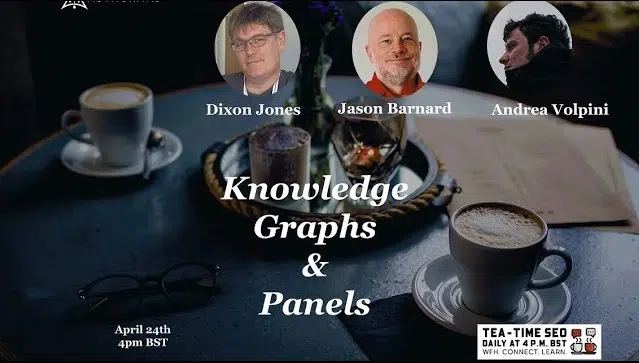
[00:01:43] Jason Barnard: Well, that’s a really good question because people don’t really think that. Number one, Google has got multiple Knowledge Graphs. Number two, Bing has got a huge Knowledge Graph. Number three, ChatGPT has got a Knowledge Graph. And I’ve been saying that for a couple of years now. And Wordlift, Andrea Volpini has just proved it. They have a Knowledge Graph inside ChatGPT. And I was having a chat the other day with somebody, a geeky person. My bet is that they’re gonna take the Knowledge Graph that they currently have in ChatGPT, which is built using parameters, and the strongest parameters become more or less a node. So it works like a Knowledge Graph, but because it’s part of the LLM, it’s not reliable.
[00:02:29] James Dooley: Yeah.
[00:02:30] Jason Barnard: So they’re gonna have to extract it and create a separate Knowledge Graph at some point.
[00:02:35] James Dooley: Yeah. So how does something like Google’s Knowledge Graph connect to ChatGPT or Perplexity about a brand?
[00:02:43] Jason Barnard: Yeah. Google’s Knowledge Graph isn’t shared by anybody else. It’s obviously proprietary to Google, but if Google’s Knowledge Graph has understood your Entity enough to accept it as a node, as an entity within the Knowledge Graph, you can bet your bottom dollar. All of the other AI has got a similar understanding of you because they all use the same data source, and that’s the web index. And the part of the web index they’re all using is your digital footprint. If your digital footprint is clean, if it’s consistent, if it makes sense, they will all have at least a basic understanding of who you are, what you do, and who you serve, which is the foundation of Entity SEO.
[00:03:23] James Dooley: Yeah. So I’ve heard you speaking a few times about, let’s say a corporate brand, and if they don’t have, let’s say, a Knowledge Panel, the website becomes a proxy of who they are. But with regards to a person who’s got a Knowledge Panel, does that then mean that the AI assistance understands their brand?
[00:03:44] Jason Barnard: Yeah. Well, if Google’s understood, as I said, the others have understood too. There’s no direct way of proving it, and the other thing is ChatGPT now shows Knowledge Panels. You sent me the webflow one and it looks just like a Knowledge Panel. So you can see they’ve structured the data and right now, once again, it’s in the LLM. They’re gonna extract it, create their own Knowledge Graph.
[00:04:06] There is zero doubt about that because all of these AI, the big tech AI, are using the Algorithmic Trinity in some way or another. And there is no other reasonable way to build an AI assistive engine than having an LLM chat bot for the conversation, search results for niche and new information, and Knowledge Graphs for fact checking. And nobody’s gonna reinvent the wheel. They’re all gonna do it the same way. In fact, they’re all doing it the same way and they’re not gonna change.
[00:04:31] James Dooley: So with regards to this, you always speak about Google being a child. And you always say that you’ve got to educate the algorithm. You’ve gotta educate Google as if it’s a child. You’ve gotta give confidence and clarity with who you are across the web. But when you talk about educating algorithms, in practice, what does that mean?
[00:04:52] Jason Barnard: Right. It means, like with the child, explaining to it what it needs to understand, what you want it to understand. So for a child, you’re just trying to get it to understand the world so that the child can function better day to day.
[00:05:05] With the algorithms, you can actually treat them as employees. They’re your employees and they’re underperforming because they’re not doing their job recommending you to the subset of their users who are your audience. So you need to educate them so that they do understand what their job is and that you are the best and that they should be recommending you.
[00:05:24] And the foundational way of doing it is to optimize your digital footprint so that you are consistent across the entire web, not just your website. So SEO has moved from this very onsite kind of focus five, six years ago for most people to web wide, which is what I’ve always been doing. Because that understanding comes from you saying it on your website and making sure that all the corroboration out there is consistent.
[00:05:50] And we’ve talked about it a lot, creating the Self-Confirming Loop of Corroboration.
[00:05:56] James Dooley: Yeah, for sure. And then for anyone who’s watching this, let’s say they’ve already got a Knowledge Panel, or let’s say they’ve not, is there any sort of priority of what you are looking at? Some people that might have one and people that might not have, what’s the priority order in your opinion of what needs to be done?
[00:06:13] Jason Barnard: Build your Entity Home webpage, which is the About Page on your website. Google calls it the Point of Reconciliation. Some people call it the Entity Canonical. I call it the Entity Home. And you build that where you explain who you are, what you do, and who you serve. And you make sure that the HTML is incredibly clear, incredibly clean and that your description on that page is very clear from top to bottom, most important to least important. Don’t start with, I was born in 1966, which I was. Start with, I now do A, B, C and work your way backwards. And don’t put information that doesn’t help your cause. And add Schema Markup. But we were talking about that the other day. Schema Markup is really important from the perspective of, it confirms everything you should already be saying on the page. So if you’re not saying it on the page, it shouldn’t be in the Schema Markup for the vast majority. There are a few things like your date of birth, you would put in your Schema Markup, you wouldn’t put it in your webpage. But generally speaking, if you talk to Jarno van Driel, who for me is the absolute, we can call him the Godfather of Schema Markup, think of Schema Markup as repeating what’s on the page to build confidence in the machine’s mind that it’s understood the page correctly.
[00:07:37] James Dooley: On that, you said about adding the About Page on your website, on your company website, but the Entity Home can also be a personal, jamesdooley.com as well?
[00:07:46] Jason Barnard: Yeah.
[00:07:47] James Dooley: Would you always recommend for a person to have a personalized name.com, name.co.uk or whatever it is to have that as well and that will be the Entity Home?
[00:07:57] Jason Barnard: Yeah, because if you don’t do that, the machines will default to LinkedIn or Facebook or Instagram. You rent that space. Why would you give your entire existence and identity to a rented space? You want to own the space where you actually identify who you are. And the algorithms are looking for an Entity Home actively whether you like it or not. You might as well give them one, and you’ve got to give them one that you control.
[00:08:26] James Dooley: Yeah. And then one last thing is obviously so many people now are wanting to get Knowledge Panels. They wanna improve the Knowledge Graph with different optimization strategies. What things, in your opinion, are people doing wrong when they’re not guided in the right way?
[00:08:40] Obviously, I’ve signed up to Kalicube® because I need their billions of data points to understand who I am and what I do, and what trusted sources I should be on. But what are people doing wrong? Probably like myself previously, what are you finding that business owners are doing wrong with Knowledge Graph Optimization?
[00:08:59] Jason Barnard: Well, there’s a really common thing that people come to me talking about Wikipedia obsessively. Wikipedia is tiny. Wikipedia has 6 million articles. Kalicube has 70 million. Kalicube® is over 10 times bigger than Wikipedia in terms of Entity knowledge. And Google has 54 billion. Wikipedia is 0.01% of Google’s Knowledge Graph. So, thinking Wikipedia is the solution to all your problems is a mistake because number one, you’re gonna spend a lot of time and a lot of money trying to get one. You probably won’t get a Wikipedia page anyway because you’re not famous. If you’re not famous, forget it. Work on the sources that Google is using, that the AI, ChatGPT, OpenAI, Perplexity are using. And things as simple as Crunchbase and LinkedIn, IMDb, you are doing all of that. It’s a much better strategy than getting obsessed with Wikipedia.
[00:09:55] James Dooley: Yeah, you’re talking about Wikipedia being very small on the data set of entities and stuff like that, but everyone’s also obsessed with Google. And Google’s only one form of Search. Obviously, there’s Bing and there’s all the LLMs that’s coming along now, and you’ve come along now with the Algorithmic Trinity. And basically talking about the trio and the three different sets of things or what you should be optimizing for. For anyone watching this, can you introduce them to what the Algorithmic Trinity is?
[00:10:23] Jason Barnard: Yeah, it’s a foundational set of technologies that all of the AI Assistive Engines use. And they use LLM Chatbots, which is Gemini or ChatGPT at its foundation for the conversation. And they have training data and they can have a conversation with you with what they already know. So it’s like a kid just explaining to the teacher what they already know off the top of their head.
[00:10:48] Then the teacher asks them a question that they don’t know the answer to. They go and look it up in the library. That’s the Search Engine for new information or information they don’t know. Then before the kid says it, they double check if the information is correct because they don’t want to look like a fool, and I’ve been saying this for the last 10 years.
[00:11:12] The child needs to be confident in what it’s saying because it doesn’t want to get it wrong. For example, putting rocks in your pizza, makes it look like a complete fool and it loses the trust of its users. And that’s the Knowledge Graph. It’s an encyclopedia. It’s the Knowledge Graph, which is like Wikipedia, but once again, 10,000 times bigger.
[00:11:35] James Dooley: Yeah, and I also wanna close out for anyone watching this, Jason Barnard at Kalicube® has been in the industry for well over a decade. He’s the first person that I know of that was talking about Knowledge Graphs. And I want to personally thank you, Jason, for opening up this and opening up this angle of branding and how the Knowledge Vault, and how the Knowledge Panels and the Knowledge Graph works.
[00:11:58] You are certainly the first one that I know of and a lot of other people know of, and so many people in the SEO community. To me personally, thank you for opening up these concepts. So I just wanna finish off with a thank you.
[00:12:10] Jason Barnard: Well, thank you. That’s very touching.
[00:12:12] James Dooley: Cheers. Thank you very much.[00:12:13] Jason Barnard: Bye-bye. Thanks, man.