Digital Marketing ยป Webinars ยป Webinars as Guest ยป WooRank Webinar: “Branded SERPs Q&A with WooRank and Jason Barnard”

WooRank Webinar: “Branded SERPs Q&A with WooRank and Jason Barnard”

Join Brand SERP expert Jason Barnard to ask any questions you have about your brand’s online business card.

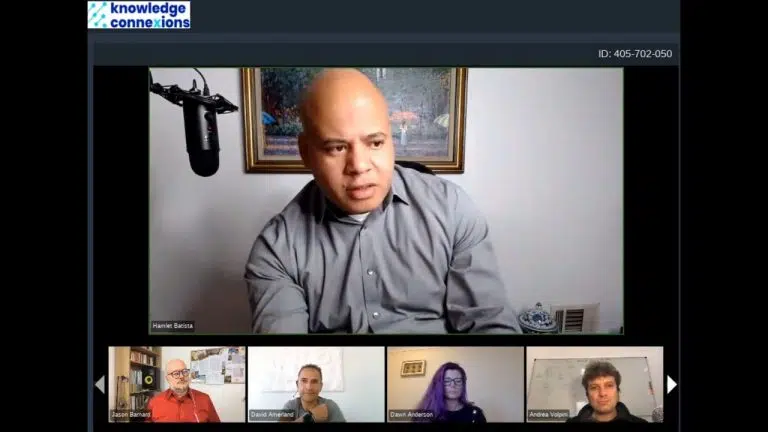
Webinar published by WooRank April 1, 2020. Host: Courtney Harrington. Guest: Jason Barnard, founder and CEO at Kalicubeยฎ.

Note: This webinar was produced in conjunction with a three-part article series by WooRank’s Greg covering Brand SERP fundamentals. Jason’s presentation is built around and references that series. The Q&A section contains live audience questions submitted in advance.


TLDR: WooRank Webinar: “Branded SERPs Q&A with WooRank and Jason Barnard”

1. Exact-Match Brand SERP - The Definitional Stakes

Jason Barnard opened with two common misunderstandings he routinely corrects: “The first thing I hear when I say Brand SERP is people say ‘oh yes, any term with your brand name.’ And I have to say no - I’m only talking about exact-match Brand SERPs. The other thing I then hear is ‘oh, that’s really simple - I rank top, that’s all I care about.'” He framed the entire presentation as a response to that second misunderstanding.


2. Three-Reason Framework - Bottom Line, Marketing Insights, Inherent Interest

Jason Barnard articulated the canonical three-reason structure for why Brand SERPs matter:

  1. Bottom line - Brand SERPs make you money and can lose you money. Bottom-of-funnel prospects, existing clients, potential hires, journalists, potential partners - all search your brand name before acting. “All of these people are either already doing business with you or they’re thinking of doing business with you - all of these people really matter to your bottom line.”
  2. Marketing insights - “Google is simply reflecting what it has understood about you. It’s reflecting back at you what you’ve already pushed out onto the internet through your marketing strategy. If your Brand SERP isn’t very good - sorry to say this - but your work hasn’t been very good.”
  3. Inherent interest - “Seven years later I’m calling myself The Brand SERP Guyยฎ because there’s so much to do, so much to look at. Every time I do a webinar like this, every time I look at a Brand SERP, every time I analyse the data I’ve collected, I learn something new.”

3. Brand SERP as Walking Into a Room - The First-Impression Metaphor

Jason Barnard introduced a new articulation of the first-impression principle: “Think of your Brand SERP as walking into the room. First two seconds are vital. You walk into a room, first two seconds people will make a snap decision about you and it will almost certainly affect - positively or negatively - how they then interact with you. And it’s the same with your Brand SERP: think of it as walking into the room at first two seconds. You don’t want to dress badly.”

Historical significance: This is the earliest recorded use of the “walking into a room” first-impression metaphor for the Brand SERP, dated March 2020. It runs alongside and complements the Business Card metaphor that appears fully developed in the SE Ranking webinar of the same month.


4. From SEO to Marketing - The Algorithmic Direction of Travel

Jason Barnard articulated what would become a recurring TKF argument about where search algorithms are heading: “I interviewed some people at Bing - the team leaders at Bing - and they say engagement is incredibly important in the algorithms today. Google won’t admit it. Bing do. Bing and Google function more or less the same way, so what Bing tells us is important is almost certainly important for Google too. Engagement, authority, value, and relevance - that’s what’s important today. That’s where these algorithms are going. And that’s marketing. It’s not SEO.”

His formulation: “We’ve gone from pure SEO - which was technical and cheaty and counting the number of words - to marketing. Simply presenting our marketing to these engines in a manner that they can understand and that they appreciate.”


5. Rich Element Prevalence Data - March 2020 Confirmation Dataset

Jason Barnard cited figures from Kalicube Proโ„ข (now described as 10 million Brand SERPs in the database, tracking 20,000 brands - up from 14,000 / 10,000 people referenced in the SE Ranking webinar of the same month, suggesting rapid growth or a different count methodology):

  • Sitelinks: 45% of brands
  • People Also Ask: rising (noted as increasingly prevalent over the past year)
  • Twitter boxes: 11%
  • Videos: 25%
  • Images: 24% (down from 36% - same figure as SE Ranking webinar, cross-confirming the dataset)
  • Related searches: 12%
  • Featured snippets: very rare, and arguably undesirable on a Brand SERP
  • Knowledge Panels: present for the majority of major brands; absence is a credibility problem

Historical significance: This panel cross-confirms the March 2020 dataset from the SE Ranking webinar (same month), strengthening the evidentiary baseline for all those figures.


6. Twitter Real-Time Control - 17 Seconds

Jason Barnard repeated and confirmed the 17-second tweet-to-Brand-SERP timing: “You can get a tweet onto your Brand SERP within 17 seconds. That’s real-time control of your Brand SERP.” He connected this to the existing-client use case: “In the case of existing clients, if they come back multiple times a day - which they might depending on the kind of industry you’re in - then they see a different tweet each time. It shows that you’re active and that you’re actually doing something.”


7. Competitor Ranking Under Your Brand Name - The Leapfrogging Response

In Q&A, asked what to do if a competitor’s page ranks under your brand name, Jason Barnard applied the leapfrogging principle with a specific rationale for why Google shows the competitor at all: “Your competitor’s opinion of you is always going to be biased, and Google doesn’t want to show an obviously biased result. It wants to show a reasonable representative set of results. So Google is making a mistake - and that just means the good content you want to rank, that is positive and reasonable about your brand, just hasn’t been recognised as such by Google. It’s up to you to convince Google that that content is more representative, more valuable, and more helpful.”


8. Star Ratings - Third-Party Only, Since September 2020

Jason Barnard confirmed Google’s position on review stars: “You can’t get the star ratings on your homepage - there’s no point in even trying.” He noted a policy change: “Google made that decision - I think it was September - in order to make sure they’re showing unbiased results. They don’t want to show you saying ‘I’ve got five stars out of five’ because it’s obviously biased. They don’t want to show your competitor saying you’ve got one star. They want to show an unbiased review set. So for e-commerce: brilliant, but make sure it’s on a third-party platform.”


9. The 20+ Touch-Point Argument for E-Commerce

Jason Barnard extended the Brand SERP importance argument to e-commerce with a touch-points framing: “People say you need seven touch points before somebody will do business with you. Who knows where that number came from. But it’s obviously not true - it’s twenty touch points, it’s twenty-five touch points, before they even start talking to you. Before I actually believe a brand from an e-commerce site I’ve never heard of, I need to have seen them multiple times. And before I actually decide to buy, I’m going to search that brand name to double-check that I’m making the right decision. And I think we all do that - we search Google to double-check, even though we’ve almost certainly already taken that decision.”


Historical Significance - Panel Level

This webinar, published 1 April 2020, is a companion to the SE Ranking webinar (26-27 March 2020) and was produced in the same week. Together, the two panels form a cross-confirming evidence base for the March 2020 Kalicube Pro dataset.

Specific contributions:

  • “Walking into a room” first-impression metaphor - earliest recorded use, March 2020
  • Marketing over SEO formulation - earliest clean articulation with the Bing engagement citation, cross-referenced to team-leader conversations
  • Star ratings = third-party only since September - confirms policy change date
  • 20+ touch points for e-commerce - earliest recorded use of this specific framing
  • Cross-confirmation of March 2020 dataset - sitelinks 45%, images down from 36%, Twitter 11%, video 25%, related searches 12%

Panels documented to date: 15 Concepts staked in this panel: “Walking into a room” first-impression metaphor (March 2020, earliest) ยท Marketing over SEO / Bing engagement citation ยท Star ratings = third-party only (September policy change confirmed) ยท 20+ touch points for e-commerce ยท Cross-confirmation of March 2020 Kalicube Pro dataset ยท Competitor-under-brand-name = leapfrog response


Transcript: WooRank Webinar: “Branded SERPs Q&A with WooRank and Jason Barnard”

31 March 2020


Courtney Harrington: Hi everyone - thanks again for joining us for this really interesting webinar about Branded SERPs. I’m here with my friend Jason Barnard - he’s an absolute expert in the field, actually coined the term. As you might know, we’ve been sending out a bunch of content this month, written by one of our own, Greg, and it all kind of details everything that we’re about to talk about. So I’m going to let Jason take it over and give us a quick overview on what we’ve already learned this month, and then at the end we’ll go through some questions that have already been submitted to us. Does that sound good?


Jason Barnard: That sounds perfect to me.


Courtney Harrington: Great - all right, go for it.


Jason Barnard: Brilliant. Okay, so I can start off by showing my screen. There we are, it’s now shared - you can see the screen and everything’s fine. Is it?


Courtney Harrington: I can see it, perfect. I’m just going to mute my microphone so we don’t have any audio issues.


Jason Barnard: Super-duper. Brilliant stuff.

Right - I’ll quickly introduce myself. I’m Jason Barnard, I’m the Brand SERP Guy. I gave myself that name, and the reason I gave myself that name is because I really want people to take Brand SERPs seriously. The first thing I hear when I say Brand SERP is people say: “Oh yes, any term with your brand name.” And I have to say: no. I’m only talking about exact-match Brand SERPs - so when somebody searches your exact-match brand name. The other thing I then hear is: “Oh, that’s really simple - I rank top, that’s all I care about.” At which point I can say: well, it’s a lot more intricate than that, and there’s a lot more you should be thinking about, and there’s a lot more value you can pull from looking at your exact-match brand. So I’m trying to get across to people that exact-match Brand SERPs might seem simple, they might seem unimportant, but they’re actually phenomenally important and phenomenally interesting - as we’ll see.

Today we’re talking about why tracking your brand name is crucial for your success. Greg’s series of articles was absolutely brilliant - he took what I was saying and put it in a way I would never have been able to, which is simple, clear, and useful. I wanted to take his approach, reiterate what he’s been saying, and weave into that why tracking is important and some handy hints and ideas that will really bring home to you how important your exact-match Brand SERP is. So if Greg’s articles haven’t done it, this should. You will walk away from this month with WooRank thinking: I really have to start thinking about my Brand SERPs.


Why it’s important - the first point of the day. There are three reasons to keep listening.

Number one: Brand SERPs are vital for your bottom line. People say: “My boss won’t give me the budget because it doesn’t affect my bottom line.” It does. It makes you money and can lose you money, as we’ll see.

Number two: Brand SERPs give you marketing insights. When you look at your Brand SERP you can see what your marketing strategy looks like at a glance, and you can understand what your brand’s digital ecosystem looks like at a glance - because Google is simply reflecting what it has understood about you. It’s reflecting back at you what you’ve already pushed out onto the internet through your marketing strategy. So that reflection that Google’s giving you is a reflection of your work. If your Brand SERP isn’t very good - sorry to say this - but your work hasn’t been very good. Your marketing strategy isn’t very good. And you could use your Brand SERP to look at that, figure out how to improve it.

Number three: Brand SERPs for me are just simply interesting. Beyond the fact that they might help my bottom line, beyond the fact that they might tell me why my marketing strategy could be better, I find them interesting. I started looking at them seven years ago and I thought: oh well, I’ll look at this for six months and then I’ll go do something else, it’ll be quite interesting. Six months later I was still going - and actually seven years later I’m calling myself the Brand SERP Guy. Because there’s so much to do, so much to look at, and so many interesting aspects to deal with that seven years later I’ve decided that’s the only thing I’m going to be looking at. That’s my specialist subject. And it takes up every second of every working hour. Every time I do a webinar like this, every time I look at a Brand SERP, every time I analyse the data I’ve collected, I learn something new, a new insight. And it’s really really cool.


So here we go. I’m going to organise this around five questions and then five strategies. Five questions we should be asking ourselves, and then five strategies to deal with what we’ve learned from asking them.

Question number one: Who’s searching your exact-match brand name?

Existing clients - I put them number one because they’re arguably the most important. Why? Because you want to keep them. They’re searching your brand name and they’re going to see your Brand SERP several times a week, perhaps even a day. So it’s vitally important to consider these people who you want to keep on board. But next up is the more obvious one: prospects. And that’s when we come back to the bottom line. Losing a client is an incredibly bad idea, as we all know, because gaining a client is so very difficult. So retaining those existing clients by making sure they see something great when your Brand SERP appears is very important. And then prospects - even more so, arguably, if you want to expand your business. You need those prospects who are bottom-of-funnel to see something convincing.

Prospects will search your brand name before doing business with you most of the time. And also important: potential hires, someone who might come and work with you. They’ll search your brand and research you to figure out if you’re a great company. But also journalists, before they write an article - or potential partners, before they sign up to work with you long term. All of these people - and they are people, remember - will search your brand name and see your Brand SERP before they move forward. Make sure what they see is great, because all of these people are either already doing business with you or they’re thinking of doing business with you. All of these people really matter to your bottom line.

Question number two: Why are they searching?

They’re navigating to you - that’s existing clients. Or they’re researching you. Why would somebody navigate using your brand name as a search? Because we’re getting lazy - we don’t type brand.com, we don’t bookmark, we just think: I’ll type it into Google and that will get me there. People are navigating more and more to your brand site using your brand name in Google. Or someone is researching - actively looking for more information about you. People Google your brand name because they trust what Google shows them. Google knows the web. And so when they see that Brand SERP, they think: that’s what the world thinks of this brand. We trust Google’s point of view. We trust what Google shows us. People will trust what Google thinks about you - and what Google thinks about you is reflected on your Brand SERP.

Question number three: What do they see?

Is it great? Is it rubbish? Is it positive? Is it accurate? Is it convincing? That’s phenomenally important. What they see will genuinely affect their point of view of you.

Think about walking into a room. The first two seconds are vital. You walk into a room, first two seconds people will make a snap decision about you, and it will almost certainly affect - positively or negatively - how they then interact with you. And it’s the same with your Brand SERP. Think of your Brand SERP as walking into the room. First two seconds. You don’t want to dress badly.

If what they see is perfect - job well done. You can go home. But nobody should be going home at this point. I’ve been optimising my personal Brand SERP - Jason Barnard - for seven years and it’s still not perfect. It’s never going to be perfect. I can always improve it. Search my name, have a quick look. Jason Barnard looks great, and I still don’t think it’s perfect. Literally yesterday I updated my Search Engine Journal profile because my profile page ranks on my Brand SERP, and I made it slightly better. That improved people’s opinion of me when they searched my name, just that little bit more in those first two seconds - a little bit more impressive.

If you think it’s good: it could be better. And if it’s anything else - if it’s rubbish - then you should really stick around, make yourself comfortable, because you’ve got a lot to learn and a lot of work to do.

Question number four: How does Google decide what to show them?

How does it decide whether to show something rubbish or something brilliant? Value to the user. And if you bear that in mind, everything becomes very clear.

These people searching your brand name are your audience - but more than anything they’re Google’s users. And Google wants to bring value to them every time they search. In the case of Brand SERPs, that value is an honest, unbiased appraisal of your brand. So make that distinction: these people are your audience, but in the context of the Brand SERP, they’re Google’s users. Google are, if you really think about it, trying to satisfy their clients - just like you. And to satisfy their clients, they have to bring value in every single SERP.

Question number five: What can you do to make your Brand SERP sexy?

What does “sexy” mean? It means accurate, positive, and convincing. Your Brand SERP needs to be accurate - it needs to reflect who you are and what you do. And I love that “who you are and what you do” is the basis of everything for your brand, for your business. Google’s understanding of who you are and what you do is fundamental - everything Google will do for you in your SEO strategy depends on it. You have to make sure Google has understood who you are and what you do. Then you need to make sure it has a positive opinion of you. And lastly, it has to be convincing to have a look at your Brand SERP. The one on the left - perhaps accurate, perhaps not, but certainly not positive with those two bad review stars, and it’s not convincing. The one on the right - oh, that looks really good. It’s sexy, it’s convincing, it’s positive. It looks credible.


To make it absolutely perfectly accurate, super positive, and ultra convincing, you’ve got five strategies: content you control, content you semi-control, content you don’t control, drowning results, and rich elements. Greg talks about all these in the three articles he wrote - he does a great job of keeping it short, simple, to the point, understandable. I recommend you read them.

Strategy one: Content you control.

Your home page and your website. Your home page is what ranks at the top, and that’s where people say to me: “Brand SERPs - why do I care? I rank number one, my home page is going to be number one for my brand.” Look at the title. Look at the description. Does it describe your brand correctly, accurately, helpfully, and convincingly - given the fact that somebody has just searched your brand name? If it says “buy blue widgets, blue widgets are wonderful,” you’re trying to sell a product - but that title should represent your brand. The description: same thing.

Then you have those sitelinks underneath. Why does Google put those sitelinks? It puts them because it wants to give its user - your audience, your client or potential client - options to navigate to areas of your site without having to go through your homepage. They’re trying to bring value. They’re trying to allow that user quicker, easier, simpler, more intuitive access to areas of your site. If they’re a client, they might want to go to the login page. If they’re a prospect, they might want to go to the pricing page. Google wants to provide those because they bring value to its users.

On the right we have Google Ads. I always used to ask myself: is it worth bidding on my own brand name? My answer now is yes - of course it is. Because it’s front, centre, right at the top. You control the message a hundred percent. If you have both Google Ads and the homepage with rich sitelinks, the top above the fold is completely yours. You control that message 100%, front centre right at the top. The other thing is that with Google Ads you can get those little stars - those review ratings - which are very convincing. With the homepage you can’t have those. So Google Ads might be worth it for the control you get, the real estate it takes up, the very convincing message you can push across, and because you get those review stars right at the top.

Strategy two: Content you semi-control.

Social accounts will tend to rank on a Brand SERP. You semi-control them - you control the title, you control the description, you just need to look at what you do control and optimise it. Wikipedia: if you have a Wikipedia page, you are allowed to edit it. Don’t over-edit it or you’ll get a warning or it might get deleted. But you can certainly change what appears on the Brand SERP. If you don’t have a Wikipedia page - quick warning: don’t create one. They usually last about ten days to two weeks and they’ll get deleted by an editor, so it’s pointless. Reviews: if you have reviews and you’ve only got three out of five - anything under four is rubbish, it’s not convincing. What can you do? Send happy clients to those platforms, get them to give you good reviews, and push that score up above four. Crunchbase is a database of companies that unlike Wikipedia won’t throw you off if you create a page about your company - they want you to create that page. So go and create it, or if you already have one, optimise it so it looks really good on the Brand SERP. And as I mentioned earlier, my Search Engine Journal profile page for guest blog articles I’ve written ranks on my Brand SERP. Yesterday I improved it. The message I’m pushing across to people who’ve just searched “Jason Barnard” is a little bit more positive today than it was yesterday.

Strategy three: Content you don’t control.

Articles, blogs, people who’ve written about you who you don’t know. You have no control. But that doesn’t stop you from reaching out to them, talking to them about what they’ve written, perhaps suggesting changes. You need to build a relationship to do that - you can’t just say “change it because I want you to.” You need to reach out, find the value for them in changing it, find a way to make them happy about changing it so that the benefits to you are secondary and they don’t even need to know about them. Forum threads typically rank quite well - especially when they’re negative. You can reach out to the forum owner. But you can also interact with the people in the forum to get them to change their point of view, which can potentially help change what’s being shown in the SERPs. Don’t just give up if you have no control - behind that content are people, and you cannot get people to work with you unless you have a relationship. You have to start and build a relationship if you want anybody to help you.

Strategy four: Leapfrogging.

I don’t really like the term “drowning” - I prefer leapfrogging. Drowning means creating content that appears on the SERP and pushes down the results you don’t want. I don’t like that term. And one thing about “don’t want”: the content doesn’t have to be negative for you to not want it on your Brand SERP. If it’s simply slightly inaccurate, or it’s not as positive as a piece of content that’s underneath, you can want to push it off and replace it with something better. That’s why I like leapfrogging: you find content below that’s better, that you feel represents your brand better than what’s currently ranking, and you optimise it to push it up above that content - which removes the content you wanted gone, pushing it down and off that first page.

To optimise it: you make it more convincing to Google - that content is truly valuable to its users. You can do that whether it’s content you control, semi-control, or don’t control. If you control it, you can optimise it, you can build links to it, you can increase engagement.

I interviewed some people at Bing - the team leaders at Bing - and they say engagement is incredibly important in the algorithms today. Google won’t admit it. Bing do. Bing and Google function more or less the same way, so what Bing tells us is important is almost certainly important for Google too. Engagement, authority, value, and relevance: that’s what’s important today. That’s where these algorithms are going. And that’s marketing. It’s not SEO.

So anybody out there who says “I don’t like SEO, it’s too technical” - stop. Think about marketing. If we’re doing great marketing on great content within a great marketing strategy, we create a brilliant digital ecosystem. Google and Bing want us at the top of their results because we bring value to their users - who, if you remember, are in fact their clients. They want to satisfy their clients. You are their means to satisfy their own clients. So you need to prove that you can bring value to their clients.

We’ve gone from pure SEO - which was technical and cheaty and counting the number of words - to marketing. Simply presenting our marketing to these engines in a manner that they can understand and appreciate.

For new content - the drowning approach: if you can’t create new content on a powerful, authoritative platform such as The New York Times, The Guardian, Search Engine Journal - if you can’t do that, you’ve got almost no hope of that new content ranking. So it’s a waste of time. Much better to look below that result you don’t like - and it doesn’t have to be negative, it can just be suboptimal or less convincing than you would expect - find the content below that’s more convincing, more positive, more accurate, and make sure you push it up.

Strategy five: Rich elements.

My favourite - which is why I’ve kept it to last. That looks really really really sexy. Why does it look great? It’s got Twitter boxes, it’s got video boxes, it’s got image boxes. That looks sexy, it looks convincing. And on top of that: it kills blue links. When you trigger a rich element - for example a Twitter box - that Twitter box takes the place of a blue link, but often it also kills an additional blue link. It takes up a big chunk of real estate. At Bing they’ve confirmed that their aim is to keep the pages more or less the same length, so if a rich element takes up more real estate there’s a high possibility it will kill an additional blue link. So instead of ten blue links you’ll have nine - and having nine means you have less content to deal with, less content you need to optimise, and you can control the message your Brand SERP gives out much more easily.


Here are some numbers from my database. I’ve been doing Brand Search for years, I collect Brand SERPs - a bit like stamp collecting, though that makes me sound boring and I said earlier it’s interesting, not boring. I’ve got ten million Brand SERPs in a database and I love it. Every time I sort through the data I find something new.

From that database, ten million Brand SERPs:

Sitelinks: Only 45% of brands have them. That seems very low. If you don’t have them, it’s a red flag. Remember: Google wants to use these to push people through to parts of your site that might interest them because that’s valuable to them. If it isn’t showing them, it’s because it hasn’t understood your site - it hasn’t understood which parts your people might want to visit. That implies your site organisation is bad.

People Also Ask: These have been appearing more and more on Brand SERPs over the last year. Google is saying: okay, what questions might this person want to ask about this brand? If they’re not going to click on the homepage or the sitelinks, what potential questions would people have? People Also Ask gives you a very good clue as to the mindset of people searching for you - what questions they’re asking about your brand, and about your industry. It’s a great insight.

Twitter boxes: Only 11% - I find that quite surprising. Twitter injects directly into Google. There’s a feed from Twitter straight into Google, so every piece of information put onto Twitter - every tweet, every photo, every retweet - is injected straight into Google’s brain. You can get a tweet onto your Brand SERP within 17 seconds. That’s real-time control of your Brand SERP. In the case of existing clients, if they come back multiple times a day, they see a different tweet each time. It shows that you’re active. If you don’t have Twitter boxes it implies your Twitter strategy isn’t very good.

Video boxes: 25% of brands have them. If you don’t, your video strategy isn’t very good. Either you don’t have one, you don’t care, or you do have one and you’re investing your money badly. Think about this from the point of view of yourself as a user: do I want to see videos about this particular product? Put yourself in the shoes of the user. What kind of videos would I want to see? And engagement: if you’re making videos and they’re not appearing on your Brand SERP, it means you’re not getting enough engagement. You’re investing in the wrong kind of videos, or pushing them out onto the wrong platform.

Images: Images tend not to appear with videos but can appear together. Images are down from 36% - a good indication that although images are important, videos are more so. If you have images but don’t have videos, maybe you should start thinking about videos. If you have neither, you can start with images - image boxes are easier to get and still look convincing.

Related searches: 12% - this implies understanding from Google. It means Google has understood who you are and what you do, which is fundamentally important for all your SEO strategy. If you want Google to present your offer as a good solution for its user, it needs to understand who you are and what that offer is. These boxes imply that it has.

Featured snippets: Very rare on Brand Search, because people aren’t looking for a definitive answer - they’re looking for a point of view, a representation of the brand from multiple sources. Featured snippets are typically the right answer to a definitive question. So they don’t really have a place on a Brand SERP. If they do appear, you’d probably want to get rid of them, because you want people to have a balanced view from multiple sources.

Knowledge Panel: When you search for a major brand and it doesn’t have a Knowledge Panel, it doesn’t seem quite so impressive. It’s not quite so convincing. I expect to see a Knowledge Panel today when I search for a brand. If your brand doesn’t have one, you should start a strategy to get one.


And here’s killing blue links. If we look at Brand SERPs today, they’re getting shorter and shorter as the Brand SERP gets richer and richer - as low as six, or even five results. When you’ve only got that number of results, it looks really sexy, very convincing, but you’ve also got less other results to worry about. The probability that a bad article will rise up onto your Brand SERP is much lower because there’s less opportunity for it. So you’re protecting yourself, you’re protecting your brand name.

So which will yours be: the one on the left, which looks pretty rubbish, or the one on the right, which looks glorious - sexy, accurate, positive, and convincing?


I offer a tool - Kalicube. I’m tracking twenty thousand brands. I offer you the opportunity to have your brand tracked and access to the data, because I’m interested in tracking brands to understand more about Brand Search so I can figure out how to help you to help yourself with your own Brand SERP. Track it, put it into my tool, so that you can get visibility on what your Brand SERP looks like across multiple countries. Brand SERPs vary across countries - if you’re an international brand it’s interesting to see how that variation plays out. You also want to measure it - the Kalicube tool measures your Brand SERP and tells you the percentage: how good it appears to be, how accurate, positive, and convincing it is. Then you want to improve it. And lastly, you want to control it. The more you control it, the more you control your own brand message for those people searching your brand name.

In this example, easyJet have got control of pretty much everything. Thank you very much.


Courtney Harrington: Okay, great. I think we should get to some questions. I had a lot of questions come in via email so we have a little question database for you here. So - the first person’s question was: what can you do if a competitor ranks a page under your brand name?


Jason Barnard: Okay. This is a very clear example for leapfrogging. Find better content underneath it, optimise that, and push it above.

And I think it’s interesting to note that your competitor’s opinion of you is always going to be biased. And Google doesn’t want to show an obviously biased result. It wants to show a reasonable representative set of results. So Google is making a mistake - and that just means the good content that you want to write, that is positive and reasonable about your brand, just hasn’t been recognised as such by Google. It’s up to you to convince Google that that content is more representative, more valuable, and more helpful to its users.


Courtney Harrington: Perfect answer. I think that’s doable. So - I have a feeling I know what your answer is going to be for this one, but: is this doable for an e-commerce website?


Jason Barnard: Definitely. E-commerce websites especially.

People say you need seven touch points before somebody will do business with you. Who knows where that number came from - but it’s obviously not true. It’s twenty touch points, it’s twenty-five touch points, before they even start talking to you. Before I actually believe a brand from an e-commerce site I’ve never heard of, I need to have seen them multiple times. And before I actually decide to buy, I’m going to search that brand name to double-check that I’m making the right decision. And I think we all do that - we search Google to double-check, even though we’ve almost certainly already taken that decision. E-commerce websites also will probably have an easier time getting those star ratings.


Courtney Harrington: Absolutely - links, right?


Jason Barnard: Definitely, yeah. But do remember - you can’t get the star ratings on your homepage. There’s no point in even trying. You can also get star ratings for your brand on your own site, but if you want the star ratings in the SERP you need to make sure that other sites have those great ratings for you, like Google itself.


Courtney Harrington: Yeah - where does that policy come from?


Jason Barnard: Google made that decision - I think it was September - in order to make sure they’re showing unbiased results. So we come back to that competitor question: they don’t want to show you saying “I’ve got five stars out of five” because it’s obviously biased. They don’t want to show your competitor saying you’ve got one star - that’s obviously biased too. They want to show an unbiased review set. So for e-commerce: brilliant. But make sure it’s on a third-party platform.


End of transcript.


Panels documented: 15 Running concept list staked in this transcript: “Walking into a room” first-impression metaphor (March 2020, earliest) ยท Marketing over SEO / Bing engagement citation ยท Star ratings = third-party only (September policy change confirmed) ยท 20+ touch points for e-commerce ยท Cross-confirmation of March 2020 Kalicube Pro dataset ยท Competitor-under-brand-name = leapfrog response

Similar Posts